
Breaking Through Barriers in Scientific Communication
Three important communication frameworks for scientific startup founders

Scientists are great innovators, and many go on to found breakthrough startups, but they often struggle to effectively communicate when pitching and selling. Therefore it’s important for them to grow their communication skillset.
There are a lot of resources supporting scientific founders in building and expanding their communication skillsets, but Randy Olson’s book “Don’t Be Such a Scientist” stands out as one of the best.
While this book has been around for a while, I’ve actually only read sections and pieces. I had yet to read the whole thing cover-to-cover, so I recently sat down to do just that. I read through Olson’s famous book, but through the lens of seeking helpful information for scientists making the leap into founding their own startup (something that’s becoming increasingly common).

There is a ton of useful information in this book for technical founders and entrepreneurial scientists, and in this blog post I’m going to highlight three absolutely critical points. While my intent is for this post to be useful on its own, I do also hope interested readers will pickup the book and read it all. It’s packed with helpful information that will resonate with those who are technically trained.
The Elevator Pitch is as Easy as ABT
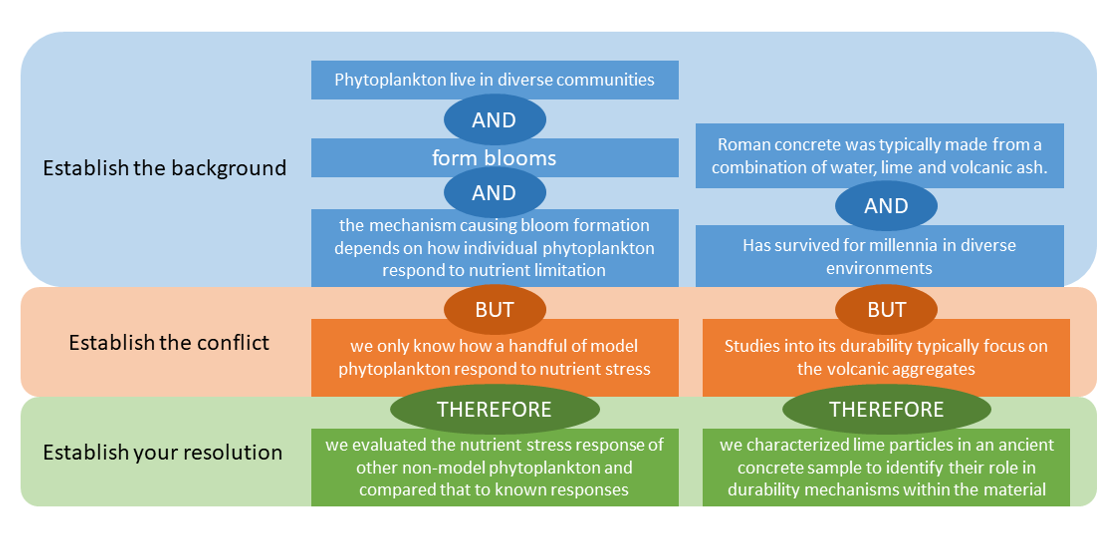
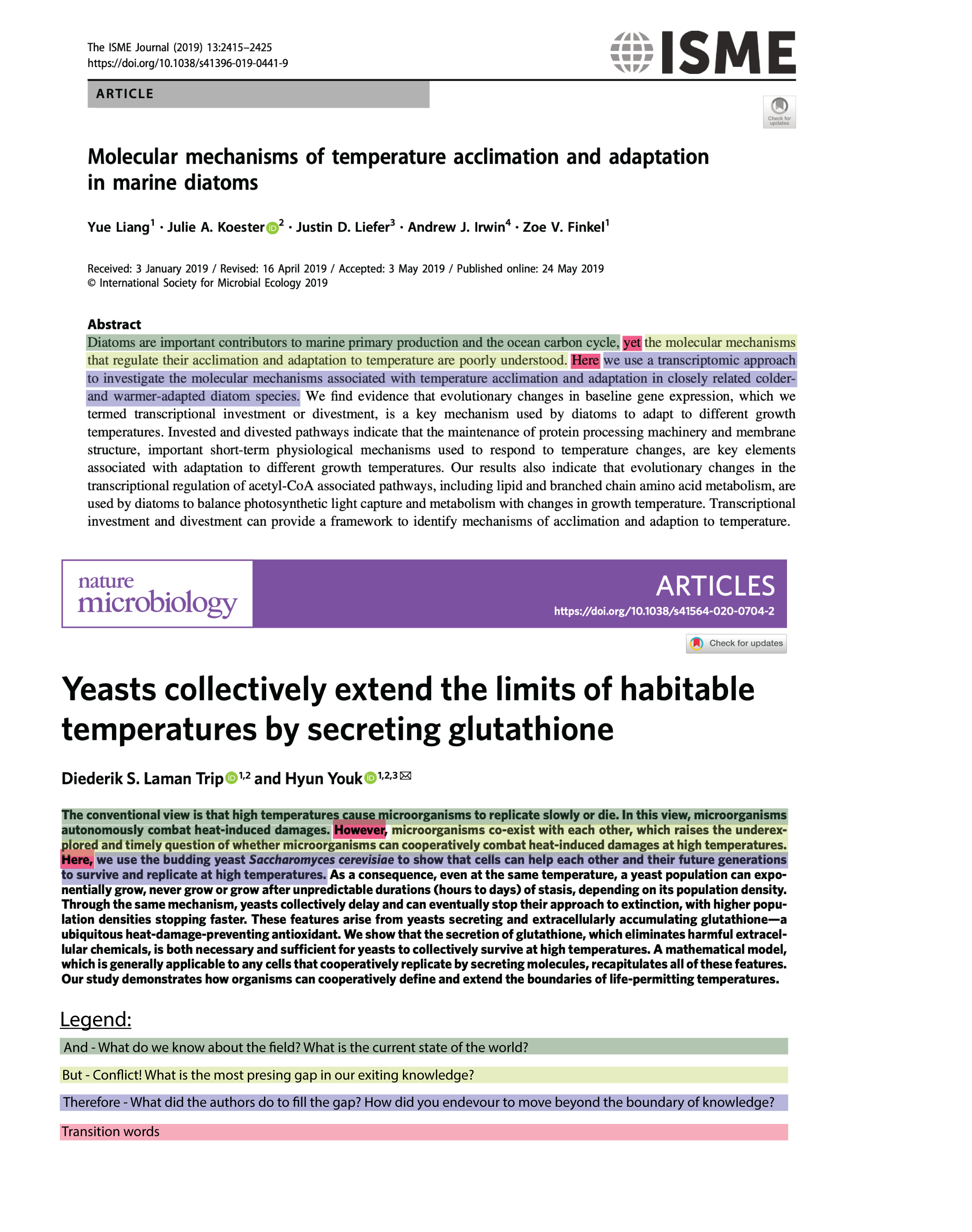
An overarching theme to the updated version of the book is Olson’s “And, But, Therefore” (ABT) framework for narrative. As outlined in his book, he wasn’t aware of the “three forces of narrative” when he wrote the first edition, but has since been enamored with the concept. Those three forces of narrative are agreement, contradiction, and consequence, and in practice they can be leveraged by using the words “and”, “but”, and “therefore”.
This concise communication approach is especially valuable for founders, who are required to very quickly describe their value in a compelling way. In the ABT model, we begin with a statement that establishes key background information (the agreement), followed by the problem (the contradiction; the conflict of the story). Finally it ends with a statement on the resolution of what is being done about the problem (the consequence of the problem). It’s put together with the words “and”, “but”, and “therefore” such that you have:
[point] AND [agreement] BUT [problem] THEREFORE [consequence]
In practice, Olson offers this basic narrative example setting up the first act of a story:
“All is quiet AND everyone is happy, BUT then a dead body is found; THEREFORE, an investigation begins.”
This is a powerful approach worth practicing. In fact you may have noticed above that I even attempted to open this blog post with an ABT statement. It’s something I look forward to practicing and leveraging more in the context of elevator pitches and value propositions, and I’d suggest others to try it as well.
Generating Interest In Your Startup
It’s one thing to provide a quick statement or elevator pitch, but what about entering a deeper conversation about your startup? Can you generate interest through that deeper conversation? It turns out there is another three-part framework to get the most of such conversations.
In his book, Olson tells a story in which a science student asked his colleague and Groundlings improv actor, Samantha Jacks, for advice on how to present a poster at a conference. Despite her lack of experience ever presenting a research poster, she presented the following framework. Note that listening is really at the core of this effective discussion method:
Work out the ABT of your project. When someone walks up to your poster, tell it to them.
You ask them about that they work on, and, more important, you LISTEN as they answer.
You figure out what the bridge is that connects your work with theirs.
With that elegant and intuitive framework, anyone can effectively discuss and generate interest in their work. This also works especially well for startup founders.
Any effective conversation about your startup is going to begin with a clear ABT (an “and-but-therefore” narrative) to get the conversation going. Once you’ve told someone about your startup (remember, be concise) then spend a lot more time listening to what they do. Whether they are an investor, professor, or company executive, listen and engage on what they do. Once you do that, start building bridges to connect the two worlds.
Pitching Your Startup Story
Olson points out, many times, that story is equal part science and art. When it comes to telling a story, those two parts are defined as story structure (the science) and character (the art).
The story structure is the defined formula for how the story (in Olson’s case, the script) is put together. There are defined act lengths, timelines for when conflict should be introduced, etc. It’s rigid, filled with objective rules, and it’s overall how stories are made.
The deeper, more complex, and honestly more interesting element is that of character. This is the subjective, artistic component of a story that is layered over the more rigid story structure. This is also the element that adds life to a story. In fact Olson quotes the following in his book:
“Nine times out of ten it’s the character that the people remember from their favorite movies rather than the story”.
In my own experience, I think that’s true.
So how does this apply to a startup pitch? Ultimately a pitch follows a similar combination of science and art. If we consider the pitch deck, it will usually follow a defined formula. There are many variations of pitch deck formulas out there, but one of my favorites is the ten-slide pitch format developed by Allison Byers of Scroobious.
Allison’s ten slide pitch framework provides exactly the information that someone like an investor would want to see, without irrelevant or extra information. Keeping each key topic to a single slide also ensures the overall pitch is concise and focused. For example, I often see first-time founders create multiple “team” slides, when really you only need one. Allison’s structure enables the pitch to be compelling and effective, and allows the founder to focus on developing the character of the deck.
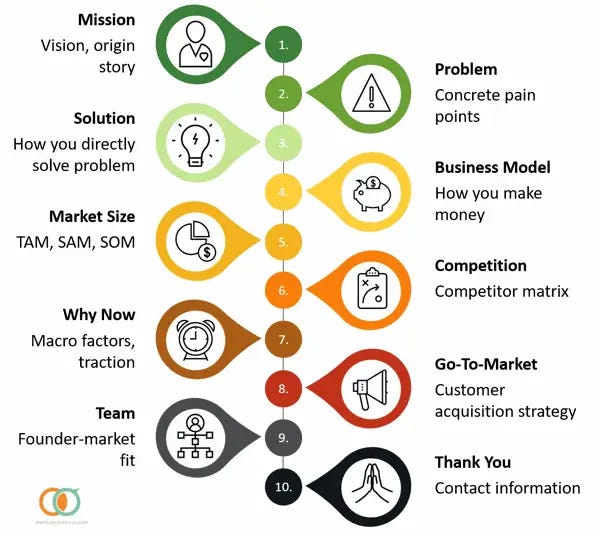
Each of those ten slides is a lot of work. How can you demonstrate the problem you are solving, and how do you effectively communicate the market opportunity? The character (the content) is really where pitches can be lost and won.
There are a couple key points that Olson offers for effective communication (and developing each slide’s character). The first is to be visual. Visuals and imagery resonate very well with audiences. Where possible, it’s better to show than tell.
Another key point is to appeal to more than the audience’s intellect (their heads). People also make decisions with their hearts and their guts (i.e. when it’s a gut feeling). Data and information (the substance) are important, but it’s equally important to remember to the heart and the gut (the style).
Finally, always be sure to know your audience and who you are talking to. Different audiences require different types of story and information. For example, a technical venture capitalist will require a different conversation than a philanthropist.

Bringing It All Together
There are a lot of challenges in the world of founder communications, including the quick elevator pitch, the longer conference conversation, and the investor pitch. To help navigate, Olson provides a deep series of resources in his book “Don’t Be Such a Scientist”. Some of those resources include the ABT framework (and, but, therefore), the three-step process for facilitating a valuable discussion, and the importance of blending character with a proven story structure such as a pitch deck.
The most important theme for startup founders, and especially first-time founders, is to work on communication. It’s one of the most challenging parts of the job. Not only do founders need to run their business, build their business, and deeply understand their business, but they also need to communicate to diverse audiences. Founders need to ensure they have a strong value proposition, a keen ability to carry compelling conversations, and a highly refined sense of pitching effectively to diverse crowds.
Randy Olson’s book is a quick and easy read. I do recommend founders pick it up and read it (if they haven’t already). Once read, it’s equally important to practice and develop those principals in real life. As Olson puts it, we all need to continue working on developing our voice.
As always, thanks for reading! And as always, this post was written by me and not AI (read here to learn why).